
Franklin Parish Arrest Records and Court Charges
Franklin Parish arrest records are created on the sheriff, jail, or arresting-agency side of the process. The official research found the Franklin Parish Sheriff's Office homepage, detention contacts, booking-status phone routes, and records-department phone routes, but it did not verify a live county mugshot or booking-search database. The official sheriff bookings page and arrests page were reviewed cautiously because some subpages had injected spam text; only cross-checkable agency statements, addresses, phone numbers, emails, and official links should be used.
The court charge record is different. A charge record is the formal accusation or count that follows the arrest. It can include the offense name, statute reference, docket or case number, bond setting, early court dates, and the prosecuting authority. Once the Fifth Judicial District Attorney files or accepts the charge, the Clerk of Court maintains the resulting case materials. Full pleas, motions, dispositions, sentences, and expungement outcomes are part of the Franklin Parish criminal court records file, not just the booking event.
The official sheriff site is the local law-enforcement starting point for custody and arrest-report questions. The same sheriff contact channel helps separate booking questions from court-charge questions when no online arrest database is available.
Find Franklin Parish Arrest Records
The access chain is practical because Franklin Parish did not have a verified public arrest-search page during research. For current custody or booking-status questions, the Franklin Parish Detention Center is the local jail contact at 318-435-8229. For a particular charge or arrest report copy, the Sheriff's Records Department phone is 318-435-9735. For court-filed charges, contact the Franklin Parish Clerk of Court at 318-435-5133 or use eClerks LA as an online starting point.
- Start with the arrest side: call the detention center for custody or booking-status questions.
- Ask the Sheriff's Records Department about a specific charge or arrest report copy if the question concerns the arrest file.
- Check eClerks LA or the Clerk of Court for filed court charges, case numbers, docket entries, and certified copies.
- Contact the Fifth Judicial District Attorney if the question is whether prosecution has been accepted, filed, amended, or dismissed.
- Use VINELink Louisiana or the Franklin Parish LA VINE roster path for custody status, not as proof of the final court charge.
For jail custody and booking detail, the separate Franklin Parish inmate records page is the better fit. The arrest-to-charge path should not be treated as a promise of mugshots, because no official Franklin public mugshot database was confirmed. Weekly bookings may be published in The Franklin Sun, according to the sheriff bookings page, but that is not the same as a searchable official case record.
Charges After Arrest in Franklin Parish
After an arrest, the District Attorney decides what formal charge, if any, should be prosecuted. The research identifies the Fifth Judicial District Attorney as the prosecuting authority for Franklin, Richland, and West Carroll parishes. The DA role is central because the arresting agency may list a suspected offense at booking, while the prosecuting office may file a different count, reduce the count, decline prosecution, or add another charge.
| Document type | Who uses it | What it does in the charge record |
|---|---|---|
| Complaint | Law enforcement or prosecution, depending on procedure | Starts or supports an accusation based on the arrest facts and probable cause. |
| Bill of information | Prosecutor | Formal criminal charging document filed by the District Attorney without a grand jury indictment. |
| Indictment | Grand jury | Formal charge returned by a grand jury, often used for serious felony matters. |
The Louisiana District Attorneys Association directory lists the Fifth Judicial District Attorney for Franklin Parish. That source is useful for court charges after arrest because the prosecutor, not the jail, controls the formal charging decision.
Franklin Parish Charge Status
A charge status tells where a count stands in the court file. One arrest can produce several counts, and each count can move differently. A single case may have one pending count, one reduced count, and another dismissed count. That is why the docket and disposition must be read count by count instead of treating all arrest charges as convictions.
| Status | What it means | Where to verify |
|---|---|---|
| Pending | The count remains unresolved and is still moving through court. | Clerk docket, court minutes, or DA status if prosecution is current. |
| Amended or reduced | The filed charge changed to a different offense, level, or count. | Amended bill, minute entry, plea papers, or docket entry. |
| Dismissed | The court or prosecutor ended that count without a conviction on that charge. | Disposition entry, dismissal order, or minutes. |
| Nolle prosequi | The prosecutor declined to proceed on the count, subject to legal limits. | DA filing, court minutes, or case disposition. |
| Convicted | A plea, verdict, or finding established guilt on that count or amended count. | Judgment, plea minutes, verdict, disposition, and sentence. |
Note: A booking charge can be an early label, while a filed charge is the court-tracked accusation accepted for prosecution.
Charges vs Convictions in Franklin Parish
Arrest records and court charges after arrest can be useful, but they do not prove guilt by themselves. The conviction question depends on the case outcome. A charge may be dismissed, amended, reduced, merged into a plea, or end in acquittal. The conviction, if any, appears through the plea, verdict, disposition, and sentencing entries in the court file.
| Record point | Charge | Conviction |
|---|---|---|
| Basic meaning | A formal accusation connected to an arrest or prosecution. | A court result based on a guilty plea, verdict, or finding. |
| Timing | Early or mid-case, often before all evidence is tested. | After plea, trial, or final court action on that count. |
| Can differ from arrest? | Yes. The DA may file different charges than the booking label. | Yes. The conviction offense may differ from the original charge. |
| Where to read it | Charging document, docket, arraignment, and amended filings. | Disposition, judgment, sentence, and certified court minutes. |
For official use, ask the Clerk of Court whether a certified copy is needed. A public search result or custody listing may not show the count-level outcome needed for licensing, court, immigration, or employment-related review.
DA and Defender Charge Roles
The Fifth Judicial District Attorney's Franklin office is listed at 6568 Main Street, 2nd Floor, Winnsboro, with phone 318-435-3386. The DA is the office that decides formal prosecution. The Clerk of Court remains the record custodian for filed pleadings and docket materials, so the DA does not replace the clerk for certified copies.
The public defender side is also separate from record custody. The District 5 public defender page serves Franklin, Richland, and West Carroll parishes through the Louisiana public defender system. The District Defender listed in the research is J. Albert Ellis, with the main office at 108 Courthouse Square, Rayville. The public defender may be relevant when a person cannot afford counsel in a pending criminal case, but case records still route through the court and clerk.
Statewide Criminal History Limits
Louisiana custody and criminal-history channels do not all answer the same question. VINELink and LA VINE can help with custody notification or jail status. Louisiana DPS&C information can help locate sentenced prisoners or VINE data for imprisoned people. Those tools are not a substitute for a Franklin Parish court charge record because they may not show the filed charging document, count-level disposition, or certified sentence.
The court path is strongest when the question is "what was charged and what happened in court." The sheriff or jail path is strongest when the question is current custody, booking status, or an arrest-report copy. A statewide or notification system may help locate a person, but the Clerk of Court and District Attorney context explain whether the arrest became a prosecution.
Expunged Franklin Parish Arrest Records
Expungement can change public access to arrest records and court charges. Code of Criminal Procedure art. 973 explains that expunged arrest and conviction records are confidential and no longer public records, with limited government access exceptions.
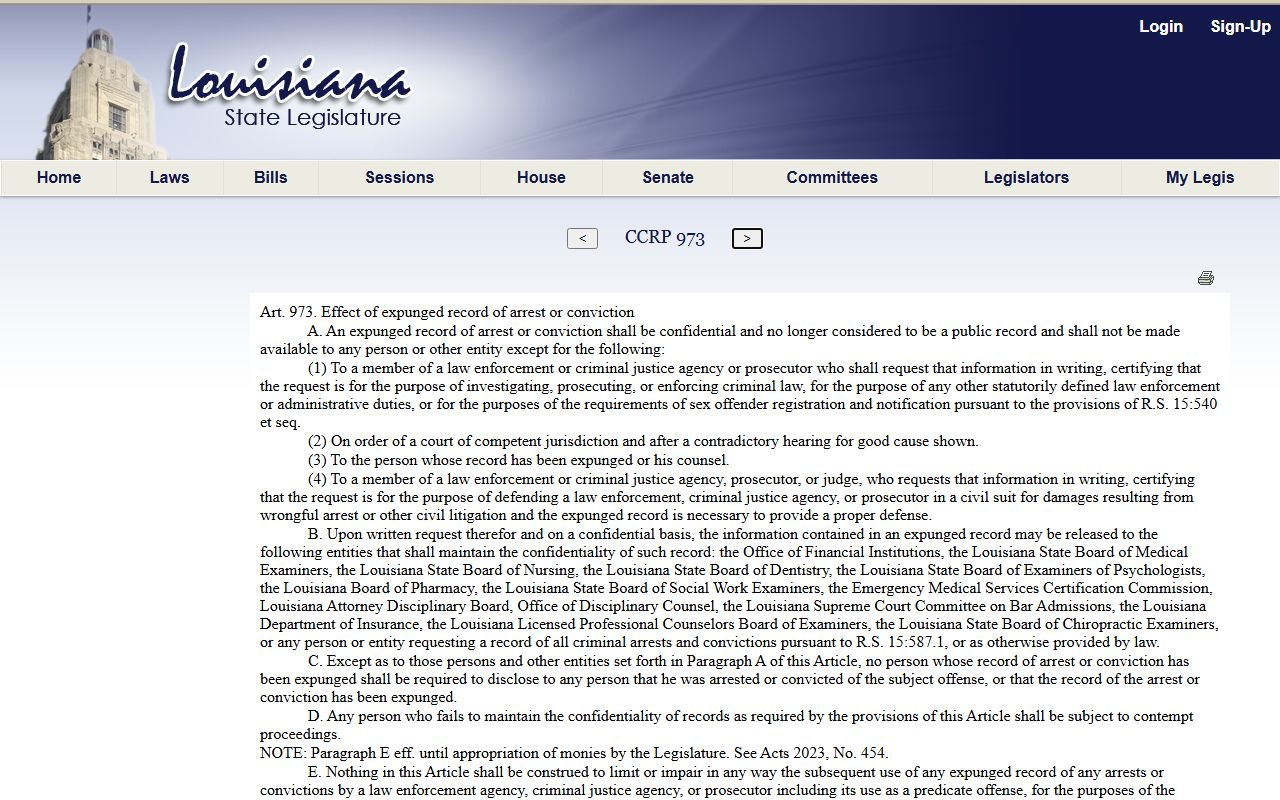
This matters for Franklin Parish arrest records because a public search can miss a record that exists but is restricted by a valid expungement order.
Code of Criminal Procedure art. 976 covers arrests that did not result in conviction under listed conditions.
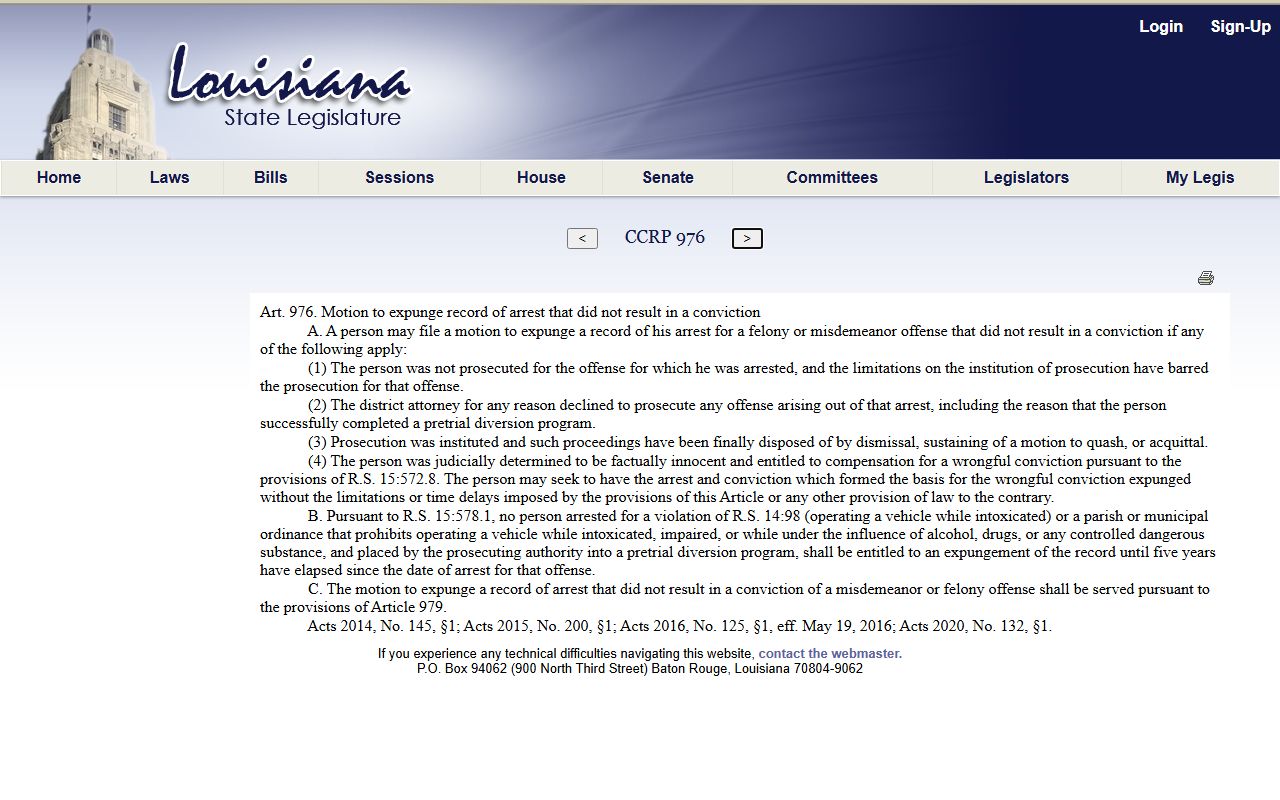
That statute is especially relevant when the arrest happened but the final court record shows dismissal, no prosecution, or another non-conviction outcome.
Code of Criminal Procedure art. 985.1 addresses interim felony-arrest expungement when the felony arrest resulted in a misdemeanor conviction.
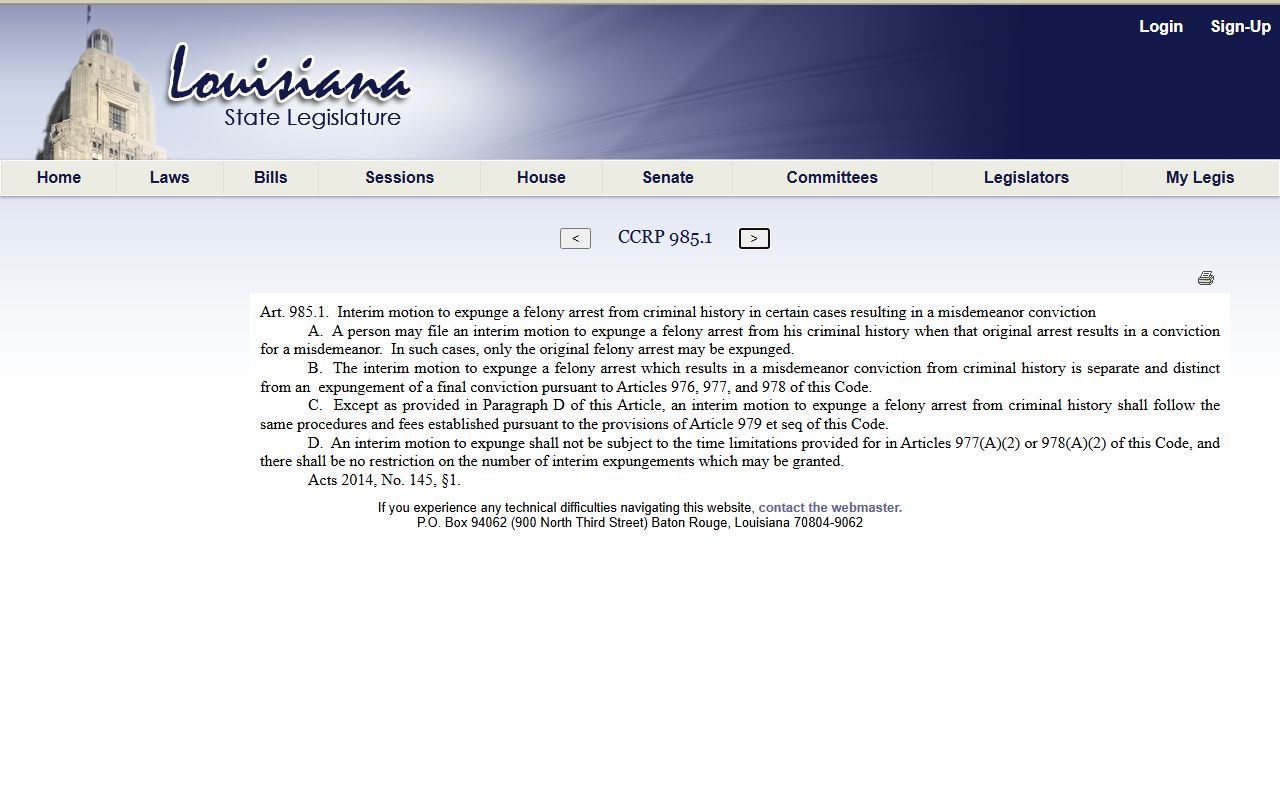
The clerk's local expungement instructions should be checked before filing because state eligibility and local filing steps both affect access.
Restricted Franklin Parish Charge Records
Not all charge-related material is public. Juvenile records are confidential under Louisiana Children's Code art. 412 except for traffic violations or other authorized access. Adoption files are also restricted. Search warrants may be sealed while active, and investigative records may be withheld when release would interfere with law enforcement work or expose protected information.
Important: Do not treat a missing online charge as proof that no arrest, warrant, sealed record, or expunged file exists.
Public copies may also redact Social Security numbers, protected minor names, financial account numbers, victim identifiers, protected addresses, and sensitive medical or mental-health information. When a charge record is needed for legal use, ask the Franklin Parish Clerk of Court whether the file is open, restricted, certified, expunged, or controlled by a court order.